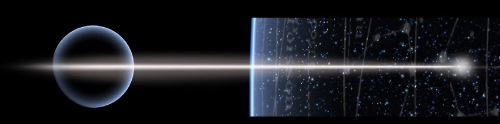
One result of the Breakthrough Starshot effort has been an intense examination of sail stability under a laser beam. The issue is critical, for a small sail under a powerful beam for only a few minutes must not only survive the acceleration but follow a precise trajectory. As Greg Matloff explains in the essay below, holography used in conjunction with a diffractive sail (one that diffracts light waves through optical structures like microscopic gratings or metamaterials) can allow a flat sail to operate like a curved or even round one. I’ll have more on this in terms of the numerous sail papers that Starshot has spawned soon. For today, Greg explains how what had begun as an attempt to harness holography for messaging on a deep space probe can also become a key to flight operations. The Alpha Cubesat now in orbit is an early test of these concepts. The author of The Starflight Handbook among many other books (volumes whose pages have often been graced by the artwork of the gifted C Bangs), Greg has been inspiring this writer since 1989.
by Greg Matloff

The study of diffractive photon sails likely begins in 1999 during the first year of my tenure as a NASA Summer Faculty Fellow. I was attending an IAA symposium in Aosta, Italy where my wife C Bangs curated a concurrent art show. The title of the show , which included work by about thirty artists, was “Messages from Earth”. At the show’s opening, C was approached by visionary physicist Robert Forward who informed her that the best technology to affix a message plaque to an interstellar photon sail was holography. A few weeks later, back in Huntsville AL, Bob suggested to NASA manager Les Johnson that he fund her to create a prototype holographic interstellar message plaque.
It is likely that Bob encouraged this art project as an engineering demonstration. He was aware that photon sails do not last long in Low Earth Orbit because the optimum sail aspect angle to increase orbital energy is also the worst angle to increase atmospheric drag. He had experimented with the concept of a two-sail photon sail and correctly assumed that from a dynamic point of view such a sail would fail. A thin-film hologram of an appropriate optical device could redirect solar radiation pressure accurately without increasing drag.
Our efforts resulted in the creation of a prototype holographic interstellar message plaque that is currently at NASA Marshall Space Flight Center. It was displayed to NASA staff during the summer of 2001 and has been described in a NASA report and elsewhere [1].
I thought little about holography until 2016, when I was asked by Harvard’s Avi Loeb to participate in Breakthrough Starshot as a member of the Scientific Advisory Committee. This technology development project examined the possibility of inserting nano-spacecraft into the beam of a high energy laser array located on a terrestrial mountain top. The highly reflective photon sail affixed to the tiny payload could in theory be accelerated to 20% of the speed of light.
One of the major issues was sail stability during the 5-6 minutes in a laser beam moving with Earth’s rotation. Work by Greg and Jim Benford, Avi Loeb and Zac Manchester (Carnegie Mellon University) indicated that a curved sail was necessary. to compensate for beam motion. But a curved thin sail would collapse immediately during the enormous acceleration load.
Some researchers realized that a diffractive sail that could simulate a curved surface might be necessary. Grover Swartzlander of Rochester Institute of Technology published on the topic [2].
Martina Mongrovius, then Creative Director of the NYC HoloCenter, suggested to C that one approach to incorporating an image of an appropriate diffractive optical device in the physically flat sail was holography; this was later confirmed by Swartzlander. Avi Loeb arranged for C to attend the 2017 Breakthrough meeting and demonstrate our version of the prototype holographic message plaque.
A Breakthrough Advisor present at the demonstration was Cornell professor and former NASA chief technologist Mason Peck. Mason invited C to create, with Martina’s aid, five holograms to be affixed to Cornell’s Alpha CubeSat, a student-coordinated project to serve as a test bed for several Starshot technologies.
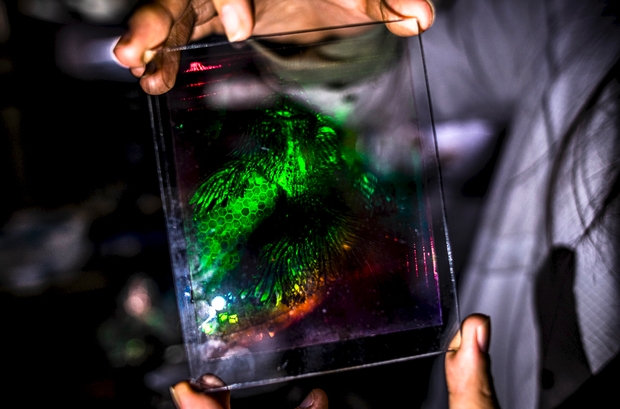
Image: Fish Hologram (Sculpture by C Bangs, exposure by Martina Mrongovius). A holographic plaque could carry an interstellar message. But could holography also be used to simulate the optimal sail surface on a flat sail?
During the next eight years, about 100 Cornell aerospace engineering students participated in the project. Doctoral student Joshua Umansky-Castro, who has now earned his Ph.D. was the major coordinator.
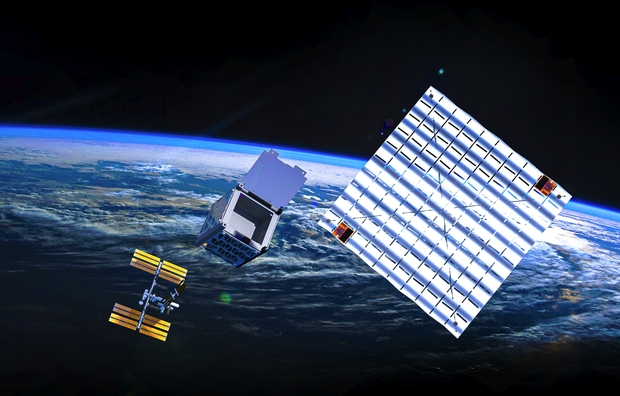
In 2023, there was an exhibition aboard the NYC museum ship Intrepid (a World War II era aircraft carrier) presenting the scientific and artistic work of the Alpha CubeSat team. Alpha was launched in September of 2025 as part of a ferry mission to the ISS. The cubesat was deployed in Dec. 2025.
All goals of the effort have been successfully achieved. The tiny chipsats continue to communicate with Earth. The demonstration sail deployed as planned from the CubeSat. A post-deployment glint photographed from the ISS indicates that the holograms perform in space as expected, increasing the Technological Readiness of in-space holograms and diffraction sailing.
In May 2026 a workshop on Lagrange Sunshades to alleviate global warning is scheduled to take place in Nottingham. The best sunshade concepts suggested to date are reflective sails. Two issues with reflective sail sunshades are apparent. One is the meta-stability of L1, which requires active control to maintain the sunshade on station. A related issue is that the solar radiation momentum flux moves the effective Lagrange point farther from the Earth, requiring a larger sunshade. At the Nottingham Workshop. C and I will collaborate with Grover Swartzlander to demonstrate how a holographic/diffractive sunshade surface alleviates these issues.
References
1.G. L. Matloff, G. Vulpetti, C. Bangs and R. Haggerty, “The Interstellar Probe (ISP): Pre-Perihelion Trajectories and Application of Holography”, NASA/CR-2002-211730, NASA Marshal Spaceflight Center, Huntsville, AL (June, 2002). Also see G. L. Matloff, Deep-Space Probes: To the Outer Solar System and Beyond, 2nd. ed., Springer/Praxis, Chichester, UK (2005).
2.G. A. Swartzlander, Jr., “Radiation Pressure on a Diffractive Sailcraft”, arXiv: 1703.02940.